Police hostage incident
Holding Out for a Hero ▸ Stiles Stilinski (2)The Police Station Hostage Crisis is the event in which Matt Daehler seizes control of the Beacon Hills Police Station, takes Carson Bradley, Stiles Stilinski, Scott McCall, and Jackson Whittemore into a lethal confrontation, and uses the Kanima as an instrument of violence. Its decisive significance lies in the collapse of ordinary legal protection: the police station, normally a place of investigation and restraint, becomes a controlled crime scene where a gun, a captive body, surveillance footage, and official evidence are all placed under Matt’s command.
Causes and Background
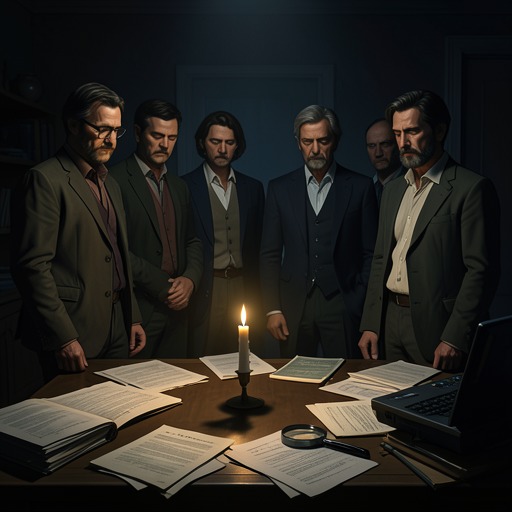
The crisis develops from the investigation into the murders connected to the Kanima. Before the siege, Carson Bradley, Stiles Stilinski, Scott McCall, and the former sheriff examine hospital surveillance from the night Jessica was murdered, searching for Matt among the crowded footage. The hospital had been jammed by a six-car pileup, creating both the scale of the search and the possibility that a crucial movement could be concealed among hundreds of patients, wheelchairs, and gurneys. The investigation therefore depends on institutional records that can identify where Matt went and when he appeared.
The case begins to harden when physical evidence links Matt to several crime scenes. The shoeprints found alongside tire tracks at the trailer park may place him at three murders—the trailer, the hospital, and the rave—and a credit-card receipt signed by Matt at the garage suggests a possible fourth connection, the killing of the mechanic. The contrast is central to the hostage crisis: the investigators are assembling a chain through surveillance, footprints, tire tracks, and a receipt, while Matt’s later objective is to erase that chain before it can become a case that survives in court.
Matt’s seizure of the station also completes a broader pattern of authority being bent into private control. Gerard Argent has already entered Beacon Hills High School as a new principal and uses his position to impose detention on students, while the school is saturated with cameras intended to enforce restrictions between Scott McCall and Allison Argent. Elsewhere, Carson Bradley and Stiles Stilinski resort to stealing a police vehicle to contain Jackson Whittemore, believing that extraordinary measures are necessary to prevent him from hurting anyone. These episodes establish a world in which institutions remain visible but their procedures are repeatedly suspended or repurposed. The hostage crisis is the most extreme version of that condition.
Participants and Stakes
Matt enters the crisis not as a conventional investigator or a suspect trying to escape quietly, but as an armed controller who forces the four young people into hostage status. Carson Bradley experiences the immediate physical threat of a gun pressed into her back as Matt pushes her down the hallway. He intends to take four hostages and is willing to let Jackson Whittemore kill people in order to accomplish it. Carson’s fear is therefore tied to two linked dangers: Matt’s direct capacity to shoot her and Jackson’s capacity to carry out violence at a distance from the person giving the orders.
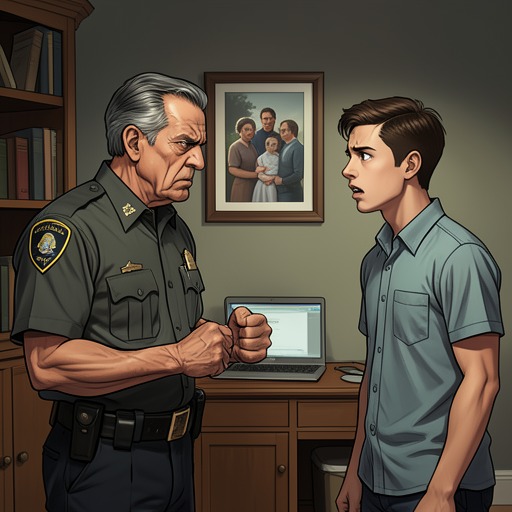
When Matt forces Carson into the office, Stiles Stilinski and Scott McCall initially react with confusion, then with immediate concern as Matt follows her with the gun hanging between his fingers. Carson moves toward Stiles, who pulls her between himself and Scott, making their physical arrangement an expression of protection even while none of them has a viable means of escape. Sheriff Stilinski rises from his seat and tries to establish a nonviolent solution, telling Matt that whatever is happening can be resolved without a gun. Matt rejects that assumption and reveals that the apparent hostage group is not exempt from his violence merely because they were not originally selected as targets.
Matt states that he wants to hurt many people and that the four young people were not on his list, though he could be persuaded to include them. His warning turns Scott’s attempt to call for help into a threat against everyone in the room. The gun transforms ordinary movements—reaching for a cellphone, speaking, or shifting position—into possible triggers for further harm. The stakes consequently move beyond the survival of Carson, Stiles, Scott, and Sheriff Stilinski: every person inside the station is exposed to the consequences of Matt’s decisions, while Jackson functions as the unseen extension of his will.
The Siege and the Loss of Control
The event’s opening value shift is a movement from investigation to captivity. Matt forces Carson through the station while keeping the gun against her spine, and her only available choice is to remain silent and follow his instructions. Once inside the office, he directs the group through intimidation rather than negotiation. His manner is not frantic; he treats the situation as something he can manipulate, and his sadistic amusement makes the danger more unstable because suffering itself appears to be part of his control.
Matt then removes Sheriff Stilinski from the immediate confrontation by ordering Stiles to handcuff his father to a bench. In the holding room, Matt points the gun at both Stiles and his father while watching his finger move along the trigger. Stiles obeys, placing his father in restraints under threat of immediate gunfire. The act reverses the usual structure of the station: the sheriff, who should control confinement, becomes confined, while Stiles is forced to participate in the removal of his own father’s freedom.
The threat becomes concrete when Scott and Carson are pushed along the hallway and discover three officers covered in blood. Two lie on their backs, another sits against the wall, and blood marks the floor and wall, including finger trails and evidence that one officer has been dragged. The scene turns the hostage crisis from a threat of violence into its aftermath. When Scott asks whether Matt intends to kill everyone in the station, Matt distinguishes between intention and agency: he claims that he thinks about killing them, while Jackson does it. The statement identifies Jackson as the weaponized body through which Matt’s violence is enacted and makes the station’s casualties part of the same chain of command.
At the sheriff’s office, Matt converts the captives into unwilling participants in the destruction of the investigation. He orders Stiles to delete the videos and Scott to shred the remaining evidence. With the gun raised, they begin complying: papers are separated into pieces, and the surveillance files are selected and permanently deleted. The destruction matters because the case has been built from precisely such records—hospital footage, shoeprints, tire tracks, and the credit-card receipt linking Matt to the garage. Matt is not merely escaping a room; he is attacking the evidentiary structure that could establish his presence at multiple murders and leave the survivors without proof strong enough to stand in court.
Evidence, Surveillance, and Institutional Power
The crisis is foreshadowed by a chain of surveillance and disciplinary systems that promise control while exposing how easily control can be redirected. At Beacon Hills High School, the arrival of Gerard Argent as principal replaces the familiar authority of Principal Stevens with an openly threatening one. On his first day, Gerard announces that at least two students will have to take the fall and remain behind for detention, immediately turning administrative procedure into a means of selecting and punishing targets. The school’s cameras extend the same logic of observation: white cameras monitor hallways, classrooms, the cafeteria, the pool, and the gym, ostensibly to enforce the distance imposed between Scott McCall and Allison Argent. By the time Matt takes over the police station, the characters already inhabit a world in which being watched is treated as protection, although the records produced by that watching can be manipulated, withheld, or destroyed.
The investigation itself repeatedly depends on fragments that must be assembled before they disappear. The former sheriff and the young investigators search hospital footage for Matt, but the six-car pileup has filled the hospital with people in wheelchairs and strapped to gurneys, making the archive both indispensable and nearly unmanageable. The crime-scene comparison follows the same investigative principle: shoeprints beside tire tracks at the trailer park could connect Matt to the trailer, hospital, and rave murders, while a credit-card receipt signed by Matt at the mechanics garage may add the mechanic’s death. The pattern is not established by one spectacular clue but by recurrence across places, records, and traces. That makes Matt’s command to delete the videos especially consequential: he understands that erasing the archive can interrupt the pattern before investigators can convert it into proof.
The event also belongs to a wider sequence of improvised and official containment. Carson Bradley and Stiles Stilinski steal a police vehicle to confine Jackson Whittemore after deciding that a van might keep him from hurting anyone, while the school’s cameras and Gerard’s detention authority impose control through institutional means. The hostage crisis fuses both forms. Matt appropriates the police station and its weapons, records, rooms, and personnel, then uses those resources against the people who would ordinarily rely on them. A place designed to document violence becomes the place where documentation is destroyed; a place designed to hold suspects becomes the place where innocent captives are forced to obey one.
Consequences and Aftermath
The immediate consequence is the conversion of the station into a lethal extension of Matt’s will. Carson Bradley, Stiles Stilinski, Scott McCall, and Sheriff Stilinski lose the protection normally associated with police custody, while Jackson Whittemore’s violence reaches them through Matt’s direction. The wounded officers in the hallway demonstrate that the crisis has already exceeded the threatened harm of a single gunman: the station contains a trail of casualties, and the captives are compelled to pass through its aftermath while Matt continues issuing orders.
The destruction of the files threatens the investigation on a practical as well as legal level. Stiles Stilinski deletes the surveillance footage, and Scott McCall shreds the remaining papers, including material that could have supported the connection between Matt and the murders. A later statement from Melissa McCall alone would not be enough to carry the case in court, so the forced destruction of the records attacks the difference between knowing that Matt is involved and proving it. The hostage crisis therefore creates a second crime scene inside the institution responsible for preserving evidence: the physical violence injures officers, while the deliberate deletion and shredding of records damages the possibility of official accountability.
The event’s ending is not a restoration of order but an intensification of uncertainty. Matt’s gun, Jackson’s killings, the blood-covered officers, and the erased files divide responsibility among controller, instrument, victims, and witnesses. The police station remains a recognizable building, yet its normal meanings have been inverted: confinement no longer guarantees safety, surveillance no longer guarantees truth, and evidence can be made to vanish by the very hands of those forced to preserve the peace. That inversion gives the hostage crisis its lasting narrative significance. It is the point at which the investigation’s fragile material basis and the characters’ ordinary civic protections are attacked at the same time, leaving survival and recognition dependent on what can still be recovered after authority has been seized from within.